
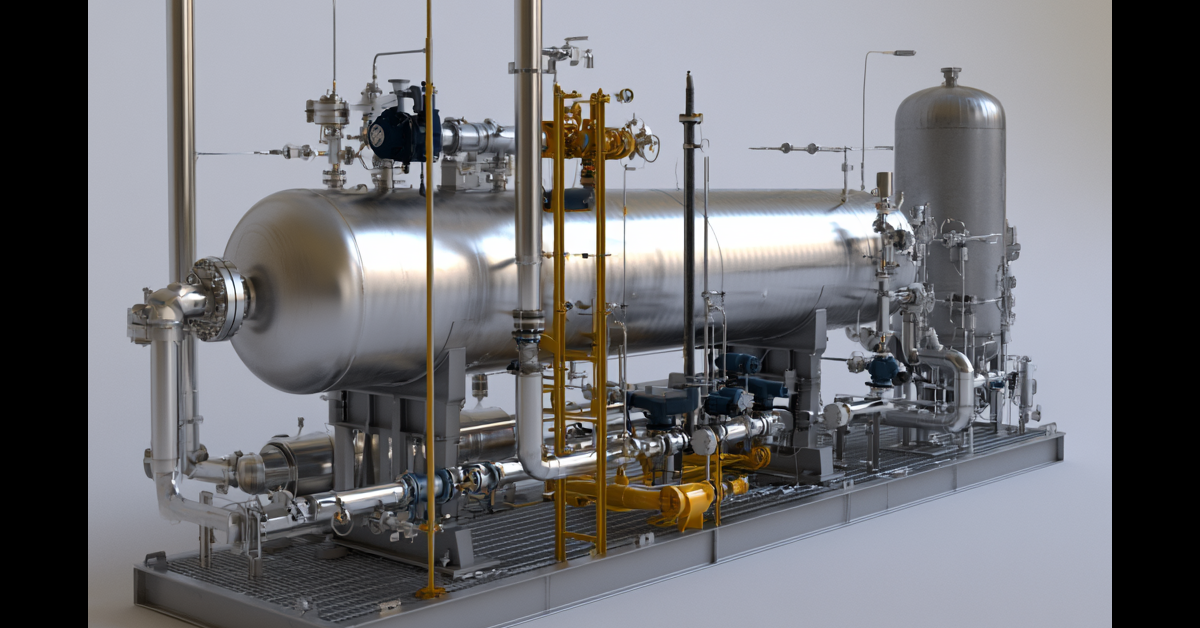
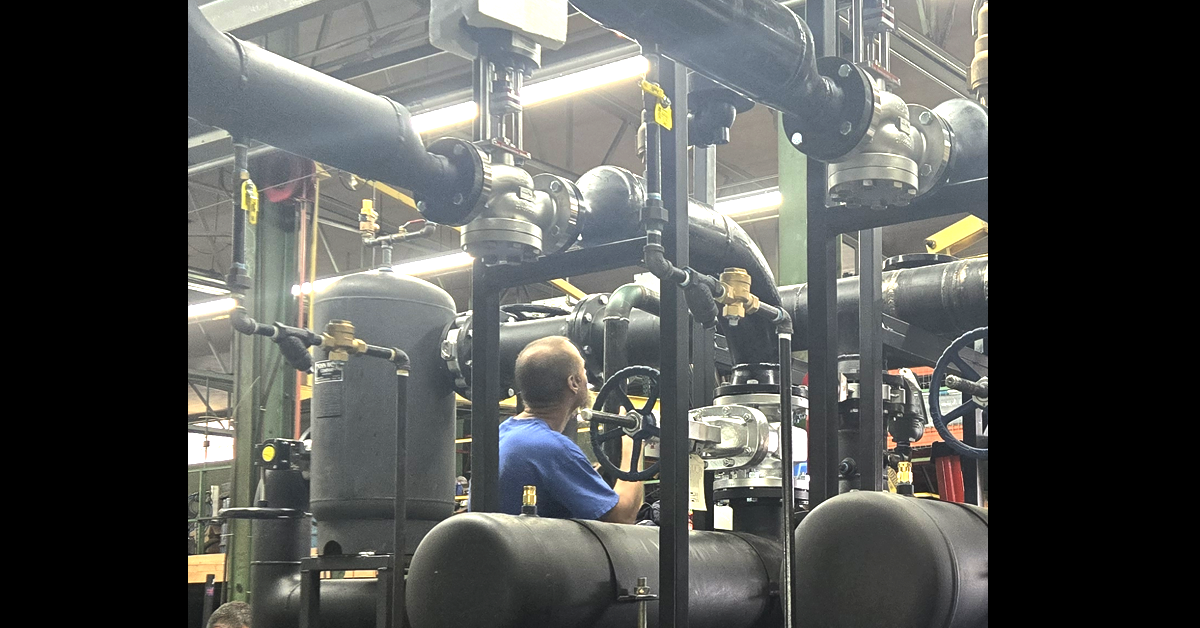
A heat transfer skid is a factory-assembled mechanical system built around a heat exchanger. It includes the heat exchanger itself, the pumps that move fluid through both sides of the exchanger, the valves and piping that connect everything, the controls that manage the system’s operation, and the instrumentation that monitors performance and communicates with the building automation system. All of it mounted on a common structural base, assembled in a factory, tested before it ships, and delivered to the job site ready to connect.
The heat transfer skid exists because heat exchangers rarely work alone. A plate heat exchanger providing building isolation between a campus distribution system and a building’s internal hydronic circuit needs pumps on both sides, isolation valves, a bypass arrangement for maintenance, temperature and pressure instrumentation, and controls that integrate with the building automation system. A shell and tube heat exchanger serving a process cooling application needs flow control, temperature control, safety relief, and in many cases chemical treatment for the process side. Specifying those components separately and coordinating their installation in the field is the alternative. Factory assembly is the better answer for most applications.
What goes on a heat transfer skid
The heat exchanger is the core component. Plate heat exchangers, shell and tube heat exchangers, and brazed plate heat exchangers are all used depending on the application’s pressure, temperature, fluid, and maintenance requirements. The heat exchanger selection drives several of the other design decisions on the skid because the connection sizes, the pressure ratings, and the maintenance access requirements all flow from the heat exchanger specification.
The pumps circulate fluid through one or both sides of the heat exchanger. In a building isolation application, there may be pumps on the primary side, the secondary side, or both, depending on whether the building has its own distribution pumps or relies on the skid to provide circulation on the building side. In a process heating or cooling application, the process side pump is typically part of the skid and the utility side connects to the building’s existing distribution system.
The valves include isolation valves on every connection for maintenance access, a bypass arrangement that allows the heat exchanger to be isolated for service without interrupting flow on either side, and in some applications a three-way mixing valve that controls the leaving fluid temperature by blending fluid that has passed through the heat exchanger with fluid that has bypassed it.
The instrumentation monitors supply and return temperatures on both sides, differential pressure across the heat exchanger to detect fouling, and flow rate where the application requires it. These measurements are used both for local display and for transmission to the building automation system.
The controls integrate all of the above. The control panel manages the pump operation, the valve positions, the temperature setpoints, and the communication with the building automation system. A skid with a well-designed control panel arrives with its sequence of operations programmed, tested, and documented before it ships.
Building isolation applications
Building isolation is one of the most common heat transfer skid applications in commercial and institutional buildings. A building connected to a campus chilled water or heating hot water distribution system needs a pressure boundary between the campus distribution system, which may operate at pressures that exceed the design pressure of the building’s internal equipment, and the building’s internal hydronic system.
The plate heat exchanger provides that pressure boundary efficiently. The building isolation skid includes the plate heat exchanger, the secondary side pumps that serve the building’s internal distribution, the isolation and bypass valves, and the controls that integrate the building’s heating or cooling system with the campus distribution. The campus side connects to the skid at defined connection points. The building side connects at its own defined points. The skid manages the interface between them.
For campus and district energy applications where multiple buildings are being connected to a distribution system as part of a capital project, factory-assembled building isolation skids allow the connection work to happen in parallel across multiple buildings rather than sequentially. Each skid is fabricated and tested at the factory while the distribution piping is being installed. The connection work happens when the piping is ready, not after a field assembly process that would delay the schedule.
Process heating and cooling applications
Industrial and institutional facilities with process heating or cooling requirements benefit from the heat transfer skid approach for the same reasons that HVAC applications do. The coordination complexity of assembling a heat exchanger system in a process environment, where the installation must be sequenced around existing production equipment and where the process fluid chemistry may have specific material and handling requirements, makes factory assembly particularly valuable.
For process applications, the skid design needs to account for the specific requirements of the process fluid on one side of the heat exchanger and the utility fluid on the other. Material compatibility, temperature rating, pressure rating, and cleanability requirements all flow from the process fluid specification. FabPro works with the process engineer’s fluid specification to select the right heat exchanger and to design the skid around the actual process requirements before fabrication begins.
Free cooling skids
Free cooling applications use a heat exchanger to transfer heat from the building’s chilled water system to the cooling tower water circuit when ambient conditions allow the cooling tower to provide cooling without running the chillers. The free cooling skid includes the plate heat exchanger, the controls that determine when free cooling is available and switch the system between mechanical cooling and free cooling modes, and the bypass arrangement that allows the chiller to serve the load when free cooling is not available.
A factory-assembled free cooling skid with the control logic for mode switching programmed and tested before it ships simplifies the commissioning process significantly. The commissioning agent confirms that the mode switching logic responds correctly to the ambient conditions in the installed configuration rather than programming and testing it from scratch during startup.
What FabPro needs to start the design
The heat transfer skid design starts with the application requirements. What fluids are on each side of the heat exchanger and at what temperatures, pressures, and flow rates. What the heat transfer duty is. What the pressure boundary requirements are between the two sides. What the maintenance access requirements are for the specific installation location. What the building automation system interface requirements are.
For heat transfer skid applications that involve Merion Pump Company pump equipment, the pump selection is coordinated between Merion and FabPro during the design process. Visit merionpump.com for more on Merion’s commercial pump capabilities. For applications where the heat exchanger on the skid is a custom fabricated coil or tube bundle, the HX Coils team handles the heat exchanger specification and fabrication. Visit hxcoils.com for more. For applications where the heat transfer skid is connected to a GP Energy Products boiler plant, the boiler and heat transfer system design are coordinated from the start. Visit gpenergyproducts.com for more.
References
1. ASHRAE. HVAC Systems and Equipment Handbook, Chapter on Heat Exchangers. Covers heat exchanger types, selection criteria, and application guidance for commercial and industrial systems. ashrae.org
2. TEMA. Standards for Shell and Tube Heat Exchangers. Covers design and fabrication standards for shell and tube heat exchangers used in heat transfer skid applications. tema.org
3. ASME B31.3. Process Piping Code. Governs pressure testing and fabrication requirements for packaged piping systems including heat transfer skids. asme.org
4. International District Energy Association. Campus Energy Systems Design Guide. Covers building isolation heat exchanger skid applications in district energy systems. districtenergy.org

Leave A Comment