
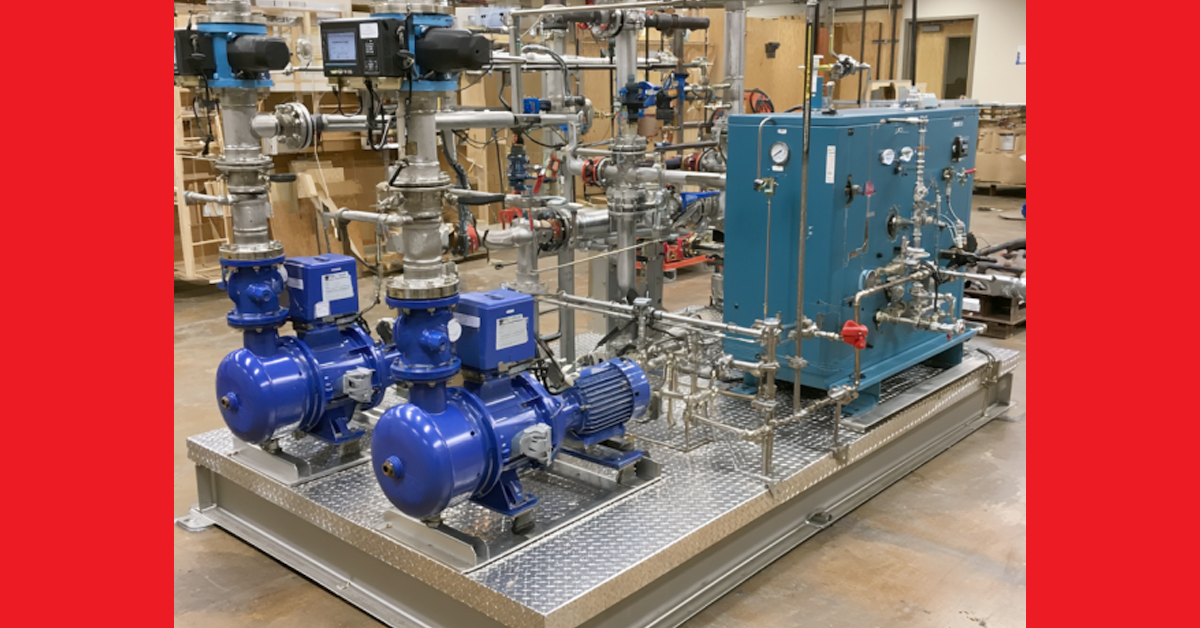
A pump skid for a standard commercial building and a pump skid for a campus or district energy application are not the same product at different sizes. The scale changes the design requirements, the structural considerations, the controls complexity, and the installation logistics in ways that compound as the system gets larger. A pump skid specification that works well for a four-pump commercial building application will miss important considerations if it is simply scaled up for a central plant serving fifteen buildings.
Understanding what large-scale pump skid applications require, and addressing those requirements before fabrication begins, is what separates a campus pump skid that installs cleanly and commissions predictably from one that generates field problems proportional to its size.
Hydraulic complexity at campus scale
Campus and district energy distribution systems have hydraulic characteristics that are more complex than single-building systems. Multiple buildings connected to a common distribution loop create variable load conditions that change continuously as occupancy patterns, weather, and building operating schedules shift across the campus. The pump skid at the central plant needs to handle those variable conditions while maintaining adequate pressure and flow at the most remote building connection point.
Variable speed drives are standard on campus distribution pump skids for the same reason they are standard in any variable flow system, but the control strategy for a campus distribution pump is more involved than a single-building application. The differential pressure setpoint that governs pump speed needs to reflect conditions at the critical point in the distribution loop, which may be a building connection that is both hydraulically remote and operating at peak demand while other buildings are at minimum load. Getting the control strategy right requires understanding the load diversity of the campus, not just the peak design flow.
For systems with multiple parallel pumps in a duty-standby or lead-lag configuration, the sequencing logic needs to account for the startup and shutdown transients that can cause pressure surges in a large distribution system. A pressure surge that is barely noticeable in a small building system becomes significant in a campus loop where the pipe volume is large and the connected buildings are sensitive to pressure fluctuations.
Structural requirements at large scale
Large campus pump skids carry significantly more weight than standard commercial skids. Pumps and motors in the size range required for central plant applications are heavy pieces of equipment, and the structural base that supports them needs to be designed for the actual load, including the dynamic loads from rotating equipment, not just the static weight of the components.
The base frame design needs to account for the natural frequencies of the rotating equipment to avoid resonance conditions that amplify vibration. A skid base that happens to have a natural frequency close to the operating speed of the pump and motor will transmit vibration to the building structure and to the connected piping in ways that cause fatigue failures over time. Structural analysis of the base frame at the design stage costs far less than investigating and correcting vibration problems after installation.
Grouting requirements for large pump skids are more demanding than for smaller equipment. The skid needs to be leveled and grouted to the mechanical room floor to provide a stable foundation that maintains alignment over time. For central plant applications where the pump skid is expected to operate continuously for decades, the foundation design is not a detail to be sorted out by the installation contractor on site. It needs to be specified before fabrication and communicated to the installation team before they arrive.
Controls integration at campus scale
Campus and district energy pump skids are integrated into building automation systems that are more sophisticated than single-building controls. The campus BAS may need to monitor and control pump speed, pressure setpoints, and sequencing across multiple pump skids at different locations in the distribution network simultaneously. The controls interface on each pump skid needs to be designed for that integration from the start.
Communication protocol standardization matters more at campus scale because the central BAS is managing a larger number of connected systems. A campus that has standardized on BACnet needs every pump skid control panel to communicate via BACnet. A campus that uses a proprietary controls platform needs the pump skid controls to be compatible with that platform. These requirements need to be confirmed before the control panel is designed, not after it is built.
Fault management and alarm routing at campus scale require more thought than in a single-building application. A pump fault on a campus distribution skid may affect multiple buildings simultaneously. The alarm structure needs to route the right information to the right people quickly enough that the impact on campus operations is minimized. The alarm configuration should be defined as part of the skid specification, not left to default settings.
Shipping, rigging, and installation logistics
Large campus pump skids present logistical challenges that smaller skids do not. A skid that is too large to fit through a standard door opening needs to be designed for field assembly or needs a clear path from the delivery point to the installation location that accommodates its dimensions. Central plant mechanical rooms on campuses are often in basement locations or in buildings with limited loading dock access. The shipping configuration, the rigging plan, and the installation sequence all need to be thought through before fabrication, not after the skid arrives on site.
For skids that are too large to ship as a single unit, modular designs that break the system into transportable sections and reconnect in the field can maintain most of the factory assembly advantages while solving the logistics problem. The field connections between modules need to be designed and documented as carefully as the factory connections, and the reconnection procedure needs to be part of the installation documentation that travels with the system.
What to bring to the conversation early
FabPro’s engineering team works from the application requirements at campus scale the same way it does at commercial scale, but the lead time for large campus pump skids is longer and the consequences of late changes are more significant. The hydraulic requirements, the structural constraints of the mechanical room, the controls integration requirements, and the shipping and rigging logistics all need to be part of the early design conversation.
For campus projects where the pump skid is part of a broader central plant upgrade that includes boiler plant work, the GP Energy Products team handles the boiler side of that conversation. For campus projects that include heat exchangers in the distribution system, the HX Coils team handles the coil specification. Visit gpenergyproducts.com and hxcoils.com for more on those capabilities.
References
1. Hydraulic Institute. Pump System Optimization Guide. Covers pump selection, variable flow design, and system curve analysis for large-scale applications. pumps.org
2. ASME B31.3. Process Piping Code. Governs pressure testing and fabrication requirements for packaged piping systems at campus scale. asme.org
3. ASHRAE. District Cooling Guide. Covers central plant pump system design for campus and district energy applications. ashrae.org
4. NEMA. Standards for Industrial Controls and Systems. Covers control panel design and BAS integration requirements for large-scale pump skid applications. nema.org


Leave A Comment