
The most common reason a skid becomes a schedule problem is that fabrication was treated as a late-stage procurement. Here is how to plan it so the skid is ready when the site is.
The problem with treating fabrication as procurement
On most commercial and industrial projects, a custom fabricated skid gets ordered the same way a piece of equipment gets ordered: after the design is far enough along that someone feels comfortable placing the order. That usually means the skid goes into the fabrication queue somewhere in the middle of the project, well after civil, structural, and mechanical rough-in are underway.
The problem is that fabrication has its own schedule that runs parallel to site construction, not after it. A custom pump skid, a booster system package, a modular mechanical room, or a heat transfer system is not something you pull off a shelf. It has to be engineered to your specific requirements, procured for materials, fabricated, assembled, and performance tested before it leaves the shop. That sequence takes time. When it gets started late, the skid becomes the last item standing between the contractor and beneficial occupancy.
The fix is not complicated. It is a sequencing decision made early enough in the project to matter.
Where the schedule typically breaks down
There are three points in a project timeline where fabrication commonly falls off the critical path in the wrong direction.
01
The first is design freeze. Fabrication cannot begin in earnest until the scope is defined: physical dimensions, connection points, operating pressures, flow rates, control requirements, and any site-specific constraints. When design freeze is delayed, fabrication start is delayed by the same amount. On projects where the mechanical design is still in flux at the 60 percent construction documents stage, a skid that needed to be in the ground at month eight is now looking at month eleven.
02
The second is the approval cycle. Shop drawings, submittals, and engineer of record review add weeks to the timeline that are often not accounted for in the original procurement schedule. A submittal that takes three rounds to approve at two weeks per round has consumed six weeks before the fabricator has cut a single piece of steel.
03
The third is long-lead components. A custom skid is only as fast as its slowest component. VFDs, specialty controls, stainless steel pressure vessels, and certain pump models can have lead times of eight to twelve weeks on their own. If those items are not identified and ordered early, they dictate the fabrication completion date regardless of everything else.
How to sequence it correctly
Getting fabrication off the critical path means treating it as an early-stage engineering activity rather than a late-stage procurement activity. In practice that means four things.
Engage the fabricator at the design development stage, not at construction documents. The earlier a fabricator is involved, the earlier long-lead components can be identified, the earlier dimensional constraints can be incorporated into the design, and the earlier the submittal package can be developed. Engaging at concept stage costs nothing and saves weeks.
Separate the scope of supply from the scope of design. The fabricator does not need a fully engineered set of drawings to begin material procurement on known long-lead items. A defined scope of supply, even at a preliminary level, is enough to start the material identification process and lock in lead times before they become schedule problems.
Build the fabrication schedule into the master project schedule explicitly. Not as a single line item that says “equipment delivery” at week twenty, but as a sequence of milestones: design freeze, submittal package, approval, material procurement, fabrication start, shop completion, performance test, delivery. Each milestone has a dependency. When the project team can see those dependencies, they can manage them.
Confirm site readiness before scheduling delivery. A skid that arrives on time to a site that is not ready to receive it creates a different problem. Storage, rigging, and sequencing with other trades all need to be coordinated. The skid should be scheduled to arrive when the mechanical room or pad is ready to accept it, not when the shop happens to be finished.
What factory performance testing means for the site
One of the advantages of modular fabrication that gets undervalued in the procurement conversation is that a properly fabricated and tested skid arrives at the site already commissioned in the factory. Pumps are running. Controls are verified. Performance has been documented against the design specification. The installation team is connecting pre-tested equipment to the building systems, not commissioning it from scratch in the field.
That distinction matters most on projects with compressed commissioning timelines and on critical facilities where system startup cannot be the phase where problems are discovered. Issues found during factory performance testing are resolved in a controlled shop environment. Issues found during field commissioning are resolved on a live construction site under schedule pressure.
The performance test documentation also creates a baseline for ongoing facility operations. When a system is performing differently from design months or years later, having factory test data to compare against tells the facility team whether the issue is in the equipment or in the system.
How FabPro approaches project sequencing
Every system we build at FabPro starts with a scope conversation before it starts with a drawing. We want to understand the project timeline, the site constraints, the critical path dependencies, and any long-lead components that need to be identified early. That conversation takes an hour and it is the difference between a skid that is on the critical path and one that is not.
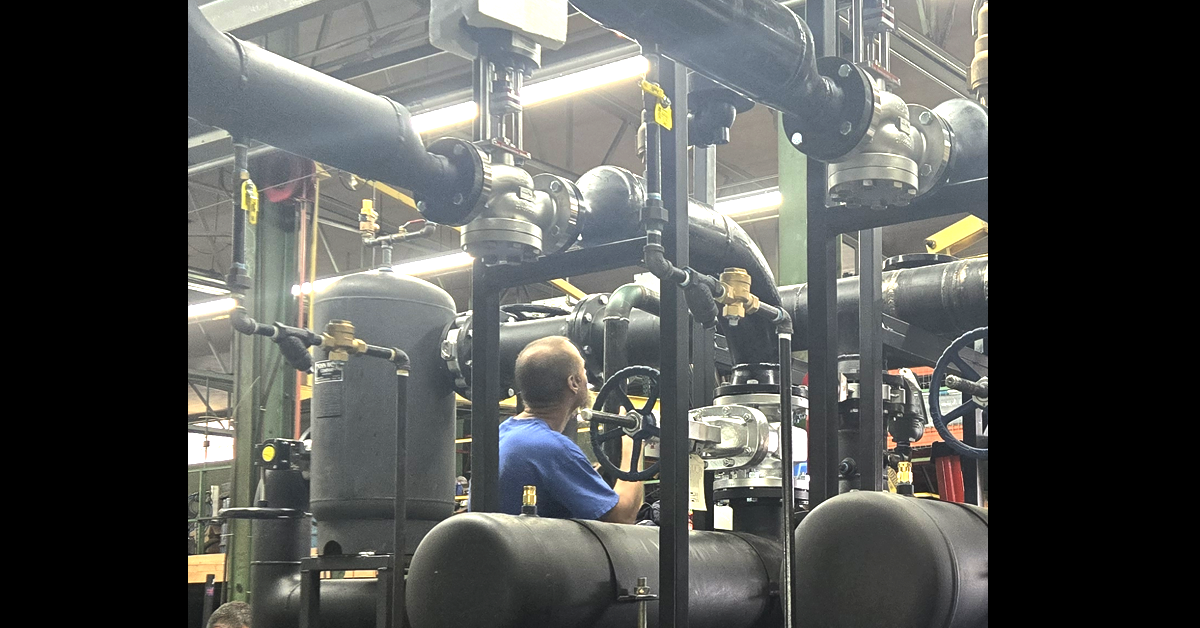
We design in Inventor. We fabricate, assemble, and performance test in our shop before anything ships. We deliver job-site ready. Whether it is a pump package, a booster system, a central plant, or a custom mechanical enclosure, the sequence is the same: understand the project, engineer to the requirements, build it right, test it, deliver it when the site is ready.
Contact Us
If you have a project with a custom fabrication scope and you are not sure whether the timeline is realistic, reach out before the design is locked. That is the conversation that keeps fabrication off your critical path.
FabPro Systems — cpepe@fabprosystems.com — 302-563-2288 — fabprosystems.com
Nationwide delivery.
References
1. Noreside Engineering Group. Modular Process Skids vs Traditional Systems. Lead time ranges by skid complexity, Factory Acceptance Testing criteria, and early engagement guidance for design and procurement sequencing. noresideengineering.com/spotlight/process-skids-vs-traditional
2. Noreside Engineering Group. What Are Process Skids. FAT process documentation, site acceptance testing baseline, and early-stage engagement recommendations for managing schedule risk. noresideengineering.com/spotlight/what-are-process-skids
3. H+M Industrial EPC. Modular Process Skid Design Guide. Front-end planning requirements, parallel construction advantages, and design-procurement-fabrication sequencing for modular skid projects. hm-ec.com/blog-posts/modular-process-skid-design
4. Glex Inc via Midstream Calendar. Modular Process Skids: A Project Manager’s Guide to Accelerating Timelines and Reducing Risk. Schedule, budget, and risk management framework for modular fabrication, including 3D design modeling and material tracking processes. midstreamcalendar.com/2026/03/15/modular-process-skids-a-project-managers-guide-to-accelerating-timelines-and-reducing-risk-by-glex-inc
5. Arcadia Equipment. Modular Process Skid Manufacturers: An Introduction. Material procurement, fabrication phase activities, US-based manufacturing advantages, and compliance requirements for custom skid systems. arcadiaequipment.com/modular-process-skid-manufacturers-introduction
6. Construction Industry Institute. Modular and Industrialized Construction Best Practices. Industry reference for parallel construction scheduling, prefabrication planning, and critical path management for modular systems. construction-institute.org



Leave A Comment